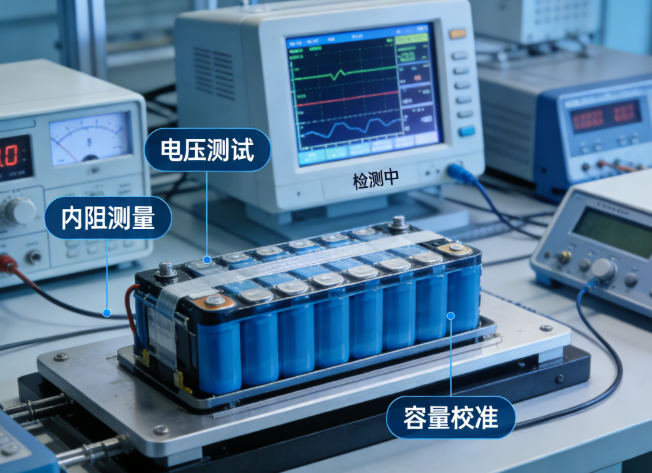
Energy Storage Batteries
Professional testing of product performance with photoelectric conversion or optical signal processing functions



Introduction to the importance and background of detection
With the large-scale grid connection of renewable energy and the increasing demand for peak shaving and frequency regulation in power systems, energy storage has become a key supporting technology for building new power systems. Lithium ion batteries play a core role in this field due to their high energy density, long cycle life, and fast response capability. However, large-scale battery integration applications also bring serious challenges to safety, reliability, and consistency. Therefore, conducting systematic and professional testing for lithium-ion batteries used in power storage is the cornerstone of ensuring the safe and stable operation of energy storage power stations, improving the full life cycle performance of battery systems, ensuring investment efficiency, and promoting the healthy development of the industry.
This testing runs through the entire chain of battery product development, type certification, factory acceptance, operation monitoring, and retirement evaluation. Its core purpose is to quantitatively evaluate the key performance and safety parameters of batteries, prevent malignant safety accidents such as thermal runaway from the source, and meet national mandatory safety regulations and grid connection standards; Through rigorous testing screening and consistency evaluation, efficient management and long-lasting operation of battery groups can be achieved; At the same time, the detection data also provides an indispensable scientific basis for the iterative optimization of battery technology, the establishment of state assessment models, and the value judgment of recycling and reuse.
Specific testing items and scope
Lithium ion batteries are used for power storage to detect multi-level objects ranging from battery cells, modules to battery clusters/systems. The specific testing items mainly include: 1. Electrical performance testing, such as capacity, energy, efficiency, rate performance, cycle life, and working condition simulation testing; 2. Safety performance testing, including response under abusive conditions such as overcharging, overdischarging, short circuit, compression, needle puncture, thermal abuse, combustion injection, etc; 3. Environmental adaptability testing, covering high and low temperature work/storage, humidity, salt spray, vibration, mechanical shock, etc; 4. Electrical safety and electromagnetic compatibility testing, including insulation resistance, withstand voltage, grounding continuity, conducted emission, and immunity.
The detection scope is clearly defined for fixed lithium-ion battery systems and their constituent units used in the field of electric energy storage, and is not applicable to consumer electronics products or electric vehicle power batteries. Testing typically targets finished batteries or systems, but also includes process testing of critical raw materials and processes. The testing environment needs to be conducted under controlled laboratory conditions to eliminate external interference and ensure comparability and reproducibility of data.
Testing instruments and equipment used
Completing the above tests requires a series of high-precision and highly reliable specialized equipment. The core instruments include a battery charging and discharging testing system, which is used to accurately control the charging and discharging process and record parameters such as voltage, current, capacity, etc. Its voltage and current measurement accuracy is usually required to be above 0.05%. Safety testing requires explosion-proof temperature chambers, squeeze needle testing machines, short-circuit testers, and combustion jet testing devices, which must be able to withstand the intense energy release generated when the battery loses thermal control.
In addition, environmental testing requires programmable high and low temperature wet heat test chambers, vibration tables, impact tables, etc. Electrical safety testing requires the use of insulation resistance testers and withstand voltage testers. The auxiliary equipment includes a data acquisition system, thermal imaging instrument, gas analyzer, and built-in sensors for monitoring the internal pressure or temperature of the battery. All devices require regular traceability calibration to ensure the authority of test results.
Standard testing methods and procedures
The standard testing process begins with rigorous sample preparation. The tested battery or system needs to be placed in a designated temperature and humidity environment to achieve stable state. All key measuring instruments should be calibrated and environmental conditions recorded before testing. The specific testing steps strictly follow the standard process: for example, when conducting a cycle life test, the initial capacity is first measured under standard conditions, and then hundreds to thousands of cycles are carried out according to the prescribed charging and discharging system (such as 1C constant current constant voltage charging, 1C constant current discharging), and the capacity is calibrated regularly to evaluate attenuation.
The security testing process is more standardized. Taking thermal abuse testing as an example, the battery needs to be placed in a temperature chamber and heated to the target temperature (such as 130 ° C) at a specified heating rate (such as 5 ° C/min) for a certain period of time. The surface temperature, voltage, and whether there is a fire or explosion of the battery should be monitored throughout the process. Each step of the operation requires synchronous and complete recording of the original data, and any abnormal phenomena need to be recorded with the assistance of image data. After the test is completed, the sample needs to be fully observed and necessary disassembly and analysis should be carried out.
Related technical standards and specifications
A series of technical standards have been established both domestically and internationally to guide the testing of lithium-ion batteries for power storage. International standards mainly include IEC62619 (including safety requirements), IEC61427-1, etc. The domestic standard system is more comprehensive, and the mandatory safety standard GB/T36276 is the foundation and core, which specifies in detail the electrical performance, safety performance, and cycle life requirements of energy storage batteries. The corresponding GB/T34131 specifies the electrical safety and electromagnetic compatibility testing methods for energy storage systems.
In addition, standards such as NB/T42091 and GB/T38031 have also put forward requirements for testing from different perspectives. These standards and specifications together constitute the technical basis for testing work, ensuring the consistency of testing methods and comparability of results between different laboratories and products. They are important technical guidelines for product access, quality supervision, and international trade.
Evaluation criteria for test results
The evaluation of the test results is strictly based on the limits or requirements specified in the relevant standards. For example, in overcharge testing, the standard may require the battery to "not ignite or explode"; In the cycle life test, it is required that the capacity retention rate of the battery after a specified number of cycles is not less than 80% of the initial value. When evaluating, it is necessary to comprehensively consider all test data and observed phenomena: the electrical performance data needs to analyze its attenuation trend and consistency; The safety test results are based on whether the preset failure criteria (such as flame, explosion, leakage, voltage drop, etc.) are triggered.
The final testing report should clearly include sample information, testing basis, testing conditions, detailed process data and curves, observed phenomena, clear conclusions, and necessary test photos or video screenshots. The conclusion should clarify whether each test result meets the standard requirements, and provide a comprehensive level assessment or risk warning for overall performance and safety, providing direct and accurate decision-making basis for the client.

TEL:
Room 101, Building 1, No. 5 Jinzhong Road, Dongcheng Street, Dongguan City, Guangdong Province
© Copyright © 2026 Dongguan Hongding Energy Storage Testing Technolog